Autonomous Machinery and Legal Liability

Much has been said and written regarding the development of autonomous and semi-autonomous construction machinery. Proponents contend it will vastly increase productivity, efficiency and quality; while critics view it as a potential nightmare, eliminating jobs, yielding poor work product, and generally wreaking havoc on jobsites.
The Current Environment:
Of course, the truth is somewhere in between.
Autonomous machinery and robotics are, in fact, making enormous strides in terms of both technology and funding (investment by Private Equity [“PE”] groups rose from roughly zero in 2020 to over $3.6 billion in 2024). By 2025, fully and partially autonomous machines had been deployed throughout the world.
Adoption has differed by region:
- In Europe, autonomous bricklaying systems, modular prefabrication and robotic rebar tying have made significant inroads, driven in part by EU-led innovation grants and sustainability mandates;[1]
- In Asia, UAVs, swarm robotics, robotic exoskeletons and AI-driven site monitoring systems have been broadly deployed as a product of national automation strategies and severe labor shortages.[2]
- In North America, adoption had lagged behind Europe and Asia, but it began to accelerate in 2024 with excavators becoming the most widely deployed autonomous machines on U.S. and Canadian construction sites, followed by haul trucks, dozers and graders. More recent additions include autonomous loaders, articulated dump trucks and pile drivers. Retrofitted autonomous systems are also swiftly gaining in popularity. North America now accounts for more than 36% of the global market for autonomous construction equipment.
As noted by Silicon Valley Bank, “four converging forces” – labor shortages, talent migration, advances in hardware and industry domain knowledge — are creating a perfect storm for widespread adoption of industrial AI in heavy machinery.[3]
Safety Issues:
Unlike less dangerous products such as passenger cars and automated conveyors, machines like excavators, loaders, dozers, etc. must perform a wide variety of tasks that may vary substantially across projects and jobsites, and virtually always pose significant safety issues, making autonomy a much riskier proposition in the construction industry than in most other fields.
- Specific Hazards: Indeed, autonomous technologies can increase certain hazards that might have been avoided with human involvement. Consider, for example, interpretation issues – where a backup sensor mistakes a person for a mound of rubble, or a machine fails to recognize an obvious [to a human] danger (e.g., overturning, overloading, ground stability, hazard proximity changes, clearance issues, etc.).
- Enhanced Safety: Autonomous technologies do, however, also present opportunities to limit exposure and remove workers from high-risk environments (e.g., demolition, blasting, unstable structures, and working at heights or in areas near power lines and/or exposed to silica dust, asbestos, PCBs, noxious fumes radiation, etc.), and in some cases, mitigate human error (g., collision avoidance systems, proximity warnings, load and tip sensors, etc.). “Falling sensor costs and powerful edge comput[ing] put autonomy within reach and enable autonomous heavy equipment to make safety decisions in milliseconds.”[4]
Potential Liabilities:
Obviously, as adoption grows, related liabilities and damages will likely do so as well; but how? And how can industry participants protect themselves legally (to the extent possible) from liabilities few may yet understand or appreciate (and some of which may not yet have manifested themselves)?
Efforts to limit legal liability typically start with trying to anticipate what could go wrong:
- Software Bugs: Software malfunctions / danger levels
- Design Defects: Machine design/performance issues with software use
- Manufacturing Defects: Defects in production process yield substandard product
- Malfunctions: Unanticipated malfunctions and increased danger levels
- Recognition Issues: Where software fails to understand or appreciate potential threats
- Failures to Stop: Where software fails to direct stoppage in dangerous situations
- Dangers of Stopping: Where software directs a machine to stop in a dangerous situation
- Failures to Correct: Where software fails to direct action necessary to correct a danger
- Overcorrecting: Where software directs and overcorrection which yields a new danger or increases an existing danger
- Human Interactions: Where software fails to anticipate a human response to a given action or inaction of a machine or an embedded software
- Others Other unanticipated dangers that require experience and/or additional programming.
Naturally, the next step is to identify the safest and most rational response(s):
- Human Safety Highest priority, requires identification of potential threats, impacts and parties impacted
- Environmental Safety Potential harm to surroundings, jobsite, location, people, infrastructure, etc.
- Machine Safety Potential damage to the machine itself
- Asset Preservation Potential damage to other assets (of owner and/or third parties)
- Liability Protection Limitation of legal liability associated with mishaps and damage
- Prioritization Prioritization of potential exposures and responses, incorporating response timing, logic, cost and other factors
- Others Other potential exposures and appropriate responses.
Industry Responses:
The sheer volume of potential issues, coupled with the magnitude of potential claims has motivated many to take a “wait and see” approach. That reluctance is, however, quickly being overcome by the suppliers’ efforts to advance their technologies and maintain or capture additional market share and builders’ efforts to reduce labor costs (currently 25% to 40% of the total average budget for a construction project).
Not surprisingly, many OEMs have opted to first create semi-autonomous machines, which require a (declining) measure of human involvement for now. Currently, “partial and conditional” autonomy accounts for the majority (just over 62%) of autonomous machine deployments in North America – where autonomous equipment now accounts for between 10% and 15% of all machine deployments.
Retrofitting machines with semi-autonomous kit has also gained momentum, as has remote management in which a single operator controls multiple machines at once. Fully autonomous machines (the fastest growing segment) now occupy 30% to 38% of the autonomous market.
This will vastly change the legal landscape…
Legal Liability:
As human involvement (and associated liability for “negligence”) diminishes, liability for product and software defects (“product liability”) will likely expand apace.
The following chart sets forth the outcomes we view as most likely. Looking forward, when an accident happens, if there is no machine operator to blame, then who (or what) is most likely to be blamed?
Whether a machine is:
- human-dependent,
- partially autonomous, or
- fully autonomous,
is likely to dramatically impact the liability picture – moving the needle toward manufacturers for “product liability” claims:
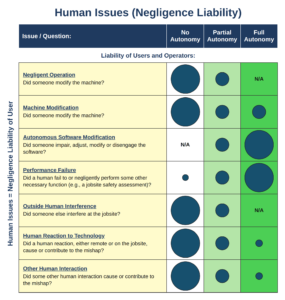

Note: “Product Liability” is a legal theory enabling an injured plaintiff to pursue recovery from all participants in the “chain of distribution” (including equipment dealers) jointly and severally (often regardless of whether the participant was negligent in making or selling the product) up to and including the manufacturer as well as software developers (in fact, the EU recently modernized its “Product Liability Directive” to do just that).
Outcomes: This suggests that, as autonomy grows, exposure to suppliers, including OEMs and dealers, will grow with it. How then, are they to protect themselves?
- Insurance: Product liability (aka “products completed operations”) coverage is widely available but often limited, capped and/or subject to exclusions. For example, it generally does not extend to software-related failures, algorithmic issues or cybersecurity breaches.
Insurers are also busily reassessing the shift from human risk to expanded product liability, and adjusting their policies to address and clarify coverages and associated limitations, exclusions and endorsements. Specialized policies have grown in popularity, and insurers are now forming data-sharing partnerships with suppliers to accumulate the information necessary to assess hardware, software, connectivity and other issues pertaining to incident origination and associated liabilities. Dealers and distributors are urged to contact their insurance agents to ensure their coverages extend to autonomous machines, robotics, AI, cybersecurity and associated product liability issues.
- Privacy Issues: Privacy issues, stalking laws, and fourth amendment concerns are also likely to bear heavily on how far automation and related data sharing can go without violating the law. This area is ripe for further litigation (and legislation).
- Documentation: Contracts and legal documents (g., Distribution and Dealer Agreements, insurance policies, maintenance and warranty obligations, software licenses, etc.) will require substantial updates in order to address a host of issues, including remote monitoring, privacy, warranty issues, repairs and maintenance, indemnity obligations and others. Doing so will be further complicated by an expanding array of applicable laws, including “Right-to-Repair,” data privacy, stalking and other similar types of legislation.
- Sales, Lease and Warranty Agreements: To that end, the first step for many in the distribution chain should be to review their agreements for the most obvious protections – for example, instructions, warnings, proper use requirements, liability and warranty waivers, “AS-IS” provisions, inspection requirements, indemnity, defense and hold harmless obligations, and of course, insurance requirements for customers and lessees.
Assumption-of-risk and liability limitations remain crucial. But autonomous equipment will also require entirely new provisions to address issues and technologies that were merely theoretical only a few years ago. For example:
“The equipment incorporates sensors, perception systems, and algorithmic decision‑making used to perform certain tasks with limited or no direct human control. It may not, therefore, function as intended under all conditions…as a result of system failures, sensor limitations, misclassification of objects, cyber security issues and/or connectivity issues. Accordingly, the user hereby acknowledges and agrees to assume all such risks and agrees to indemnify, defend and hold harmless the Dealer ….”
- Dealer and Distribution Agreements: Dealer Agreements, always important, will remain subject to being overridden by dealer laws. But because few of those laws yet address autonomous machines, AI, cybersecurity, data privacy and the like, contract terms will have outsized impact for the foreseeable future. And because most dealer laws do not extend to wholesale distribution relationships, distributors should be even more aware of the need to incorporate protections into their Distribution Agreements with OEMs.
- A Useful Interim Option: Consider using an Addendum incorporating the necessary provisions, rather than re-writing all of your agreements from the ground up, at least initially. Doing so can be an effective stopgap while considering more comprehensive updates.
Conclusion:
The expansion of machine autonomy presents a vast and compelling opportunity for growth. But it also presents perhaps the greatest expansion of legal exposure since the inception of modern product liability law in the early 20th century. And because the issues are only partly visible at this stage, they will almost certainly continue to expand for years to come. As always, feel free to contact us if we can help.
James R. Waite, Esq., is a corporate and transactional attorney with more than 30 years of experience advising clients on the purchase, sale, and leasing of heavy equipment, as well as the acquisition and disposition of businesses that manufacture and distribute it. He has served as legal counsel to manufacturers, dealers, and equipment lessors, and is the author of the American Rental Association’s book on equipment rental contracts.
Mr. Waite is a veteran of the United States Air Force and holds a Bachelor of Business Administration in Finance from the University of Texas at San Antonio, a Juris Doctor from St. Mary’s University, and a Master of Business Administration from Northwestern University
Mr. Waite can be reached at (866) 582-2586, or via email at jrw@jwlinternational.com.
Contributing Authors: Helen B. Hester, Esq. and Logan Berland made substantial contributions to this article.


